


Why Every MSME Owner Should Suspect Every Photo They Receive
That Cracked Egg Photo Just Cost Your Business few Lakhs

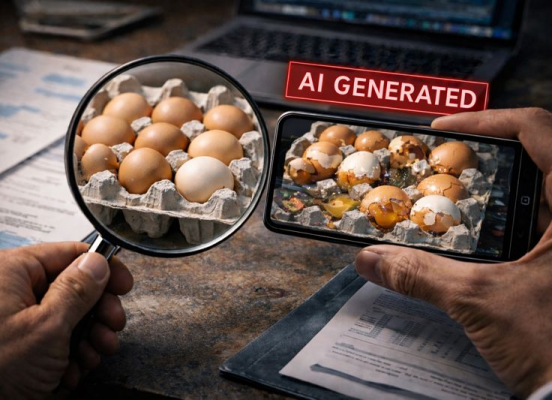
A quick commerce platform user recently created an AI-generated image of a delivery tray with cracked eggs to claim a refund. The company paid out. Multiply this by thousands of similar incidents across India, and you begin to understand why insurance companies are staring at potential losses exceeding seventy-four billion dollars annually from AI-generated fraud. This is not a distant threat anymore. The fake receipt on your desk right now could have been created in thirty seconds using freely available AI tools.
Before generative AI became accessible to anyone with a smartphone, such frauds required effort. You had to stage an accident, manually edit photos, or forge documents painstakingly. The barrier to entry was high enough to deter casual fraudsters. Insurance companies had decades of experience identifying inconsistencies in lighting, shadows, and metadata. The playing field, while not level, was at least visible.
That world ended in late 2023. Today, platforms like ChatGPT and Midjourney can generate photorealistic images of car accidents, property damage, or medical injuries in seconds. Insurance companies report a four hundred seventy-five percent surge in synthetic voice fraud attacks, with AI-driven scams now accounting for over half of all digital financial fraud. The numbers are not projections. They are the current reality.
Indian MSMEs sit at the intersection of this crisis in three ways. First, as businesses file legitimate claims, your genuine evidence will face intense scrutiny and extended processing times. Second, as suppliers to larger organizations, you will be asked to implement verification systems you have never heard of. Third, if you operate in logistics, construction, real estate, or e-commerce sectors that depend on visual evidence, you are vulnerable to fraud from customers, partners, or employees armed with nothing more than a smartphone.
Starting 2026, the Insurance Regulatory and Development Authority of India is expected to mandate stricter verification protocols for claims involving digital evidence. Companies that upgrade their verification systems now will survive what experts are calling the fraud arms race. Those that don't will either bleed money to fraudulent claims or spend exponentially more on manual forensic investigations. Platforms with integrated AI detection systems report catching ninety-seven percent of deepfake attempts, avoiding losses exceeding twenty million dollars.
Forward-thinking MSMEs are already implementing solutions. Indian startups specializing in deepfake detection for financial institutions are emerging as trusted partners for businesses seeking local expertise. For companies needing immediate, proven solutions, global platforms like Sumsub offer AI-powered verification with integrated deepfake detection. Their system verifies authenticity in under fifty seconds with ninety-five percent accuracy and serves over two thousand clients across fintech, e-commerce, and trading sectors. Business owners can explore their solutions directly at https://sumsub.com or test their free deepfake detection tool also to understand the technology firsthand.
The bigger opportunity is not just protection but positioning. As India's insurance market races toward fourteen trillion rupees by 2030 and mandatory AI compliance becomes standard, MSMEs demonstrating robust content authentication will have a competitive edge. Government initiatives under the IndiaAI Mission are funding deepfake detection projects led by IITs, with grants and technical support available for businesses implementing these solutions.
The transformation from trust-based to verified-digital transactions is here. Every document, image, and voice call in your business now needs authentication it did not require twelve months ago. Indian startups, backed by one hundred thirty million dollars in cybersecurity investments, are building affordable detection tools specifically for businesses like yours.
Test your vulnerability with free deepfake detection at TruthScan or explore MSME specific solutions through the platforms mentioned above. The infrastructure exists. The government support is real. The only question is whether you will implement protection before or after your first AI-generated fraud incident costs you everything.

You may also like


