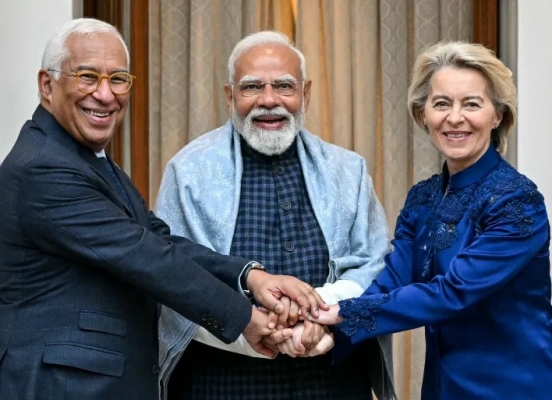
‘Mother of All Trade Deals’ Finalised: India–EU Conclude Free Trade Agreement Talks

After years of slow progress and repeated pauses, India and the European Union have reached a decisive breakthrough on their long-pending Free Trade Agreement often described as the “mother of all trade deals” due to its scale, complexity, and strategic importance. The development marks a critical moment in India’s trade diplomacy, particularly at a time when global supply chains are being re-shaped and geopolitical alignments are shifting.
The India–EU FTA covers one of the world’s largest economic partnerships. Together, India and the EU account for a substantial share of global GDP, trade flows, and consumer demand. Negotiations had remained stalled for years due to sharp differences on tariffs, regulatory standards, sustainability commitments, labour provisions, and market access for sensitive sectors. The recent breakthrough signals that both sides have found workable middle ground on several of these long-standing friction points.
From India’s perspective, the agreement is strategically significant as it deepens access to one of the world’s most sophisticated consumer markets while reducing over-dependence on a limited set of export destinations. For the EU, India represents a fast-growing market, a manufacturing partner of scale, and a geopolitical counterweight in the Indo-Pacific region. The renewed momentum reflects a shared recognition that economic cooperation is now inseparable from strategic alignment.
Crucially, the agreement goes beyond tariff reductions. It is expected to include provisions on services trade, investment facilitation, regulatory cooperation, digital trade, intellectual property, and sustainability frameworks. For Indian industry, especially MSMEs integrated into export supply chains, the deal could influence compliance norms, product standards, and long-term market positioning in Europe. For European firms, it opens deeper engagement with India’s manufacturing, infrastructure, and services ecosystem.
The timing of the breakthrough is equally important. With global trade facing fragmentation, rising protectionism, and increasing use of non-tariff barriers, the India–EU FTA sends a signal in favour of rule-based trade and long-term economic partnerships. It also aligns with India’s broader push to embed itself more firmly into global value chains while upgrading quality, standards, and competitiveness.
While formal ratification and phased implementation will still take time, the political convergence itself is a milestone. The India–EU FTA is not merely a trade agreement it reflects a re-calibration of economic ties between two major democratic economies, setting the tone for how India engages with advanced markets in the years ahead.

You may also like