Export Promotion Mission Gains Momentum with Focus on MSME Finance

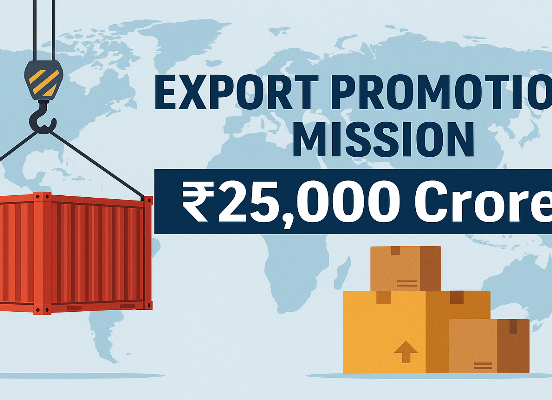
The government’s Export Promotion Mission (EPM) is beginning to translate from policy intent into on-ground support, with key financial interventions for MSME exporters rolling out in the current financial year. While the overarching framework was approved earlier, developments this week indicate steady implementation of measures designed to ease credit constraints and strengthen export competitiveness, particularly for micro and small exporters.
The Export Promotion Mission, approved by the Cabinet with an outlay of ₹25,060 crore, is structured around two pillars Niryat Protsahan, which focuses on financial support, and Niryat Disha, which addresses non-financial enablers such as market access, compliance, and institutional coordination. Together, these aim to create a more predictable and supportive export ecosystem, especially for smaller firms that struggle to scale internationally.
A key element gaining traction is targeted financial support for exporters. Under Niryat Protsahan, interest subvention on export credit has begun to lower the cost of working capital for exporting MSMEs. For many small firms, high interest rates and limited access to affordable credit have been persistent barriers to fulfilling export orders or entering new markets. By reducing financing costs, the scheme seeks to improve cash flow stability and make export operations more viable, particularly in price-sensitive global markets.
Alongside this, the rollout of enhanced collateral guarantee support through the Credit Guarantee Fund Trust for Micro and Small Enterprises (CGTMSE) is addressing another long-standing bottleneck. Under the Export Promotion Mission framework, collateral-free credit support of up to 85 percent for micro and small exporters is intended to encourage banks to lend more freely for export-related working capital. This is significant for smaller exporters who often lack sufficient assets to offer as collateral, despite having confirmed orders or strong market potential.
Taken together, these measures reflect a shift toward risk-sharing between the government and the banking system, rather than placing the entire burden on small businesses. By reducing lender risk and borrower cost simultaneously, the mission attempts to tackle both supply- and demand-side constraints in export financing.
Beyond finance, the Export Promotion Mission also seeks to improve coordination across export-related schemes and institutions. Niryat Disha focuses on aligning market development efforts, export promotion activities, and institutional support so that exporters face fewer fragmented processes. This integrated approach is particularly relevant for MSMEs, which often lack the bandwidth to navigate multiple schemes, agencies, and compliance systems simultaneously.
From a broader perspective, the ongoing implementation of EPM comes at a time when global trade conditions remain uncertain and competition among exporting nations is intensifying. For Indian MSMEs, sustaining export growth increasingly depends not just on product quality but also on access to affordable capital, predictable policy support, and reduced transaction friction.
While it remains early to assess the full impact, the steady rollout of EPM interventions suggests a move away from one-off export incentives toward a more structured support framework. If execution remains consistent, the Export Promotion Mission could play a meaningful role in strengthening the financial backbone of MSME exporters and improving their ability to compete in global markets over the medium term.

You may also like